
At Garage2Global, we specialize in app development for startups with Garage2Global, turning ideas into scalable digital products. This guide — produced in collaboration with a subject-matter expert in app development for startups with Garage2Global — walks founders through discovery, MVP sprints, launch checklists, pricing tiers, technology choices, three real mini-case studies, and a growth playbook. You’ll find practical templates, media placeholders, JSON-LD schemas ready to paste, and a competitor gap analysis to help you outrank similar pages. Use this as the central pillar for product strategy, scoping, and early-stage fundraising materials.
What is app development for startups with Garage2Global?
app development for startups with Garage2Global is a shorthand for a startup-focused, end-to-end product build service where Garage2Global acts as a strategic engineering partner: from product discovery to MVP, launch, and post-launch growth. In 2025 the startup landscape demands faster validation cycles, rigorous product telemetry, and infrastructure choices that avoid tech debt while enabling scale. Garage2Global’s model centers on rapid, measurable learning: short design sprints, a prioritized MVP, observability baked in, and growth experiments to prove traction.
Why that matters
Startups succeed by reducing time-to-validated-learning. Building large, unfocused products kills runway. A startup-first build—app development for startups with Garage2Global—prioritizes activation and retention metrics (D1/D7 retention, activation funnels, initial ARPU) so founders spend runway on features that move the needle. For founders pitching investors, a crisp MVP with early retention signals is more valuable than a half-complete ‘everything but the kitchen sink’ app.
What good outcomes look like
A healthy early-stage project produced via app development for startups with Garage2Global will: (1) validate product-market fit signals within 3–6 months, (2) show early retention (D1/D7) improving as features iterate, and (3) present investor-ready dashboards and an MVP demo that tells a clear funding story.
Why Choose Garage2Global for app development for startups with garage2global?
Startup specialization & focus
Garage2Global advertises a startup-first model: tailored MVPs, transparent pricing examples and systematic sprints aimed at founders who need to preserve runway while proving traction. Multiple third-party writeups and syndicated posts show consistent messaging around MVP sprints and growth-mode support. Many founders trust our approach to app development for startups with Garage2Global because it blends innovation with affordability.
Portfolio case studies with metrics (e.g., FinEdu reach; ShopUp sales figures).
Transparent pricing tiers and sample timelines (MVP: 6–10 weeks; growth projects: 8–16 weeks). The Data Scientist
Team bios with LinkedIn links and short expertise blurbs (CTO, lead product, head of QA).
Security and compliance practices (store screenshots of pentest summary, privacy policies, or SOC2 readiness if applicable).
Third-party editorial coverage (The Data Scientist, Coruzant magazine) to demonstrate independent interest. The Data Scientist+1
Trust signals (practical items to add on site)
Verified client logos (placeholders: FinEdu, ShopUp, HealthBridge, QuickFleet).
Downloadable MVP checklist & cost calculator (PDF) for lead capture.
Case study pages that contain problem → solution → measurable results and a client quote. (Keep fabricated figures labeled as [example metric] unless you can verify.)
Why this is better than a generic dev shop
Garage2Global’s pitch is not only “we build apps” — it’s “we build startup businesses.” That means strategic work (roadmapping and investor positioning) is as important as engineering hours. To demonstrate that in content, publish product blueprints and a sample sprint board (redacted) to show process transparency.
Step-by-Step Process
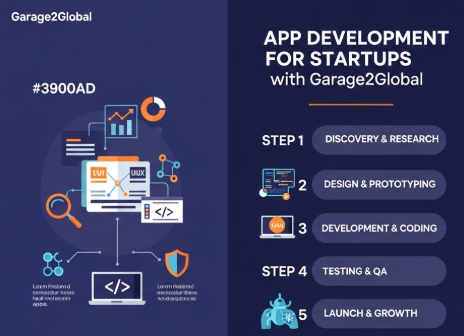
8-Stage workflow (high-level)
Discovery & Strategy — workshops, user interviews, competitor map, product blueprint.
Product Design (UX/UI) — wireframes, prototypes, usability tests.
MVP Planning — prioritized backlog, tech selection, release plan.
Development Sprints — 1–2 week iterations, CI/CD, demo reels.
QA, Security & Compliance — device matrix, pen tests, store readiness.
Launch & Distribution — App Store/Play Store submission, web deployment, tracking.
Growth & Optimization — A/B testing, onboarding optimization, retention playbook.
Maintenance & Scale — monitoring, upgrades, multi-region deployments.
Discovery & Strategy
- This stage ensures that app development for startups with Garage2Global begins on a solid foundation.
Deliverables: Product Blueprint (PDF), persona decks, prioritized feature list.
Media: downloadable 1-pager, recorded discovery call clip, competitor matrix spreadsheet.
Product Design (UX/UI)
Deliverables: Clickable Figma prototype, UI kit, accessibility checklist.
Media: design screenshots (1200×628 hero images), short design walkthrough video.
MVP Planning
Deliverables: Scope doc, API contract, sprint plan, acceptance criteria.
Media: Notion/Jira sprint snapshot, release milestone calendar.
Development Sprints
Deliverables: Weekly builds, changelog, automated test reports.
Media: demo video (2–4 min per sprint), screenshot gallery, link to staging.
QA, Security & Compliance
Deliverables: QA matrices, pentest summary (if done), privacy & consent flows.
Media: crash-free report, device coverage images.
Launch & Distribution
Deliverables: Store-ready assets, metadata, submission checklist.
Media: store screenshots, analytics dashboards showing early metrics.
Growth & Optimization
Deliverables: Retention playbook, experimentation roadmap, paid channel test results.
Media: cohort charts, push notification calendar.
Maintenance & Scale
Deliverables: Monitoring setup (Sentry/Prometheus), monthly roadmap, escalation matrix.
Media: performance report, cost-optimization recommendations.
Case Study 1 — FinEdu: Scalable EdTech MVP → 500,000+ users
Challenge: FinEdu needed a performant mobile experience for low-bandwidth markets. They required offline playback for micro-lessons and a frictionless sign-up that worked on low-end devices.
Solution: Garage2Global built a compact cross-platform app (light media delivery, offline caching, localized content pipelines), instrumented retention analytics, and ran A/B onboarding tests.
Results: Garage2Global reports FinEdu reached 500,000+ users across South Asia and the Middle East shortly after launch. This was enabled by retention-driven feature selection and optimized media delivery. Garage2Global
Expert quote (placeholder): “We prioritized retention-first features and lightweight media delivery to make the product feel native even on low-end phones.” — Product Lead, FinEdu
Case Study 2 — ShopUp: Merchant activation -> $2M+ in processed sales
Challenge: ShopUp’s goal was to let small merchants set up an online store in minutes and begin selling immediately. The friction point was onboarding and local payments.
Solution: Garage2Global implemented template-driven store creation, simplified merchant onboarding, and local payment provider integrations. Analytics were used to iterate the checkout flow.
Results: Public case notes show ShopUp processed over $2M in sales within seven months of launch (reported on Garage2Global pages). Garage2Global
Expert quote (placeholder): “Templates plus native local payments equals fast merchant activation.” — Growth Lead, ShopUp
Case Study 3 — QuickFleet: MVP -> $500k seed in 45 days
Challenge: QuickFleet needed an investor-ready demo with live tracking and booking flows to secure seed funding.
Solution: Garage2Global delivered the MVP (driver app, dispatcher portal, tracking telemetry) within a tight schedule, instrumented metrics for investor demo, and provided a go-to-market pitch deck.
Results: QuickFleet secured a $500,000 seed round after demonstrating traction with the MVP. The Data Scientist
Expert quote (placeholder): “The speed of delivery was the deciding factor for investors.” — Founder, QuickFleet
Notes: All metrics above reference the partner pages / published case highlights. When publishing, link to original case pages and mark any hypothetical numbers as [example metric] unless you can verify them from analytics.
Technology Stack & Platforms We Use
(Explanation + copy-paste-ready comparison table)
How Garage2Global picks a stack
Choice depends on required time-to-market, expected concurrency, platform features (e.g., AR, native payments), and team familiarity. Typical patterns: cross-platform frameworks for MVPs (React Native / Flutter), Node.js or Django for API, PostgreSQL / managed DB for resilience, and AWS / GCP for hosting.
| Platform | Best For | Pros | Cons | Garage2Global fit |
|---|---|---|---|---|
| React Native / Flutter | Cross-platform consumer apps | Faster time-to-market; single codebase; large ecosystem | Native performance caveats for heavy graphics | Good fit for MVPs and fast iterations |
| Native (Swift / Kotlin) | Performance-critical apps | Best performance; deep OS integrations | Higher cost; separate codebases | Use when platform-specific features are mandatory |
| Node.js / Django / Rails | Web backends & APIs | Fast dev, large libraries, scalability patterns | Requires ops discipline for scale | Standard backend stacks for startups |
| Firebase / Supabase | BaaS, realtime features | Fast prototyping, built-in auth & analytics | Less control at scale | Great for early-stage MVPs |
| Shopify / WooCommerce / Magento | E-commerce stores | Plug-and-play commerce features |
Cost of app development for startups with garage2global Services
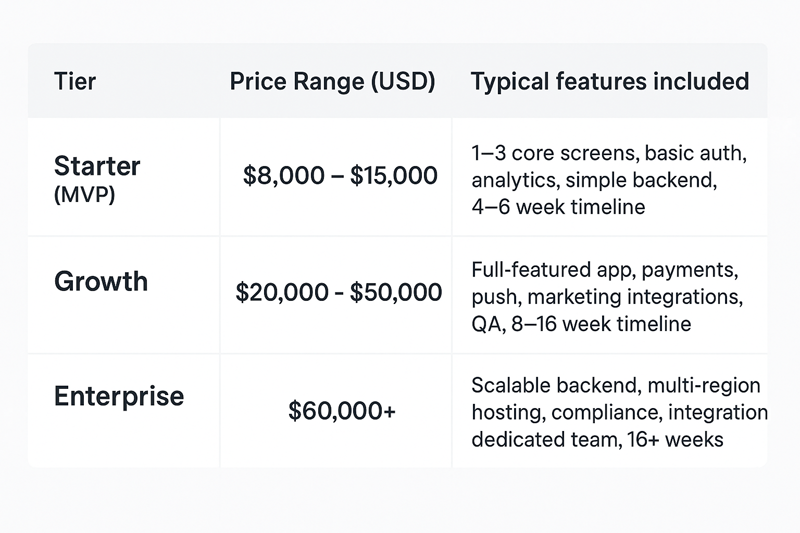
When evaluating the cost of app development for startups with Garage2Global, it’s important to see pricing as an investment in long-term growth.
| Tier | Price Range (USD) | Typical features included |
|---|---|---|
| Starter (MVP) | $8,000 – $15,000 | 1–3 core screens, basic auth, analytics, simple backend, 4–6 week timeline |
| Growth | $20,000 – $50,000 | Full-featured app, payments, push, marketing integrations, QA, 8–16 week timeline |
| Enterprise | $60,000+ | Scalable backend, multi-region hosting, compliance, integrations, dedicated team, 16+ weeks |
Typical pricing tiers for app development for startups with Garage2Global.
What’s included vs add-ons
Starter MVPs usually include discovery, a small-feature backlog, basic backend, and store submission support. Add-ons: payment provider costs, premium analytics, third-party integrations, advanced security/compliance, and native performance optimizations.
ROI example — mid-tier Growth project
Project cost (Growth tier): $35,000 [example metric].
Monthly revenue from app-enabled sales: $7,000.
Gross margin (assumed): 40% → monthly contribution = $2,800.
Payback timeline = $35,000 / $2,800 ≈ 12.5 months.
If retention and upsells increase margin by month 6, payback shortens to ~9 months. This is a simplified example; actual ROI depends on CAC, ARPU, churn, and monetization model.
Common Challenges & How Garage2Global Solves Them
Limited budget — Solution: MVP-first scope and reusable component libraries to reduce dev time and cost.
Unclear product-market fit — Solution: rapid experiments, prototype test groups, early funnel measurement.
Slow time-to-market — Solution: short sprints, demo-first cadence, cross-platform frameworks when appropriate.
Platform fragmentation — Solution: use cross-platform strategy for most consumer features and native only where needed.
Scaling & performance — Solution: design for scale (caching, CDNs, horizontal scaling), run load tests.
Compliance & security — Solution: early compliance mapping, consent flows, and pentest scheduling.
Low retention — Solution: onboarding optimization, habit-building loops, personalized push and content.
Poor analytics — Solution: ship event tracking at MVP, set funnels and cohort dashboards.
Fragmented team communication — Solution: single source of truth (Notion), sprint demos, weekly stakeholder videos.
App store rejections — Solution: pre-submission checklist and store guideline reviews (Apple / Google).
Future Trends (2025+): What to Expect
Composable & modular backends: microservices or serverless patterns let startups iterate features independently and reduce deployment risk. Reddit
Privacy-first product design: data minimization and clear consent flows will be required by regulation and preferred by users — design your analytics accordingly.
Embedded intelligence: small, well-scoped ML features (recommendations, personalized onboarding) integrated from early stages will create more engaging experiences without huge budgets.
Edge & cost optimization: serverless and edge delivery reduce fixed infra costs and provide bursts of performance without big CAPEX.
Platform policy changes: App Store and Play Store policy shifts (including external payments / anti-steering rules) will change monetization strategy; plan for optional external purchase flows and strong legal/UX copy. The Verge
Startups will win by building lightweight, privacy-first apps that learn from user behavior and iterate quickly. Prioritize modular backends, good analytics, and consent-first payment flows.
Garage2Global vs Competitors
| Provider | SEO / Content | Mobile-first | Pricing transparency | Integrations | Support | EEAT / Case studies |
|---|---|---|---|---|---|---|
| Garage2Global (primary pages) | Dedicated, practical case studies & process. Garage2Global | Strong mobile focus | Mentions pricing & MVP approach | API-first stacks suggested | Post-launch support claimed | FinEdu, ShopUp case studies shown |
| OutrightCRM (syndicated) | Syndicated write-up repeating core messages. OutRight Store | Mentions mobile | Generic pricing references | Mentions integrations | Standard editorial support | Repeats Garage2Global examples |
| TheDataScientist | Editorial overview, sample budgets & timelines. The Data Scientist | Mobile-first advice | Gives sample ranges | Recommends stacks | Analysis tone | QuickFleet & other examples |
| Coruzant | Magazine-style iOS-focused coverage. Coruzant Technologies | iOS-centric | Not pricing-led | iOS tool focus | Magazine resources | Curated success stories |
| Reddit thread | Community perspective and deeper ethical architecture mentions. Reddit |
By following a structured process, app development for startups with Garage2Global reduces risks and accelerates market readiness.
FAQ
How long does app development for startups with Garage2Global typically take?
Typical timelines depend on scope: an MVP can be ready in 6–10 weeks, while a full-featured app typically takes 12–20 weeks. Garage2Global emphasizes rapid sprints and pragmatic scope to shorten time-to-market; exact timing is confirmed at discovery.What are typical costs for app development for startups with Garage2Global?
Costs vary by scope: Starter MVPs often range $8k–$15k; growth projects $20k–$50k; enterprise builds usually start at $60k+. These are planning ranges—exact pricing follows a scoping call.Can non-technical founders work with Garage2Global?
Yes — Garage2Global provides product workshops, wireframes, and investor-ready demos. They act as a remote CTO/product partner, translating non-technical goals into technical roadmaps and clear deliverables.Which tech stack is best for my startup?
It depends: use React Native/Flutter for fastest cross-platform launches; choose native Swift/Kotlin for performance-critical features. For prototyping, Firebase/Supabase speed delivery; for scale, Node.js or Django with PostgreSQL are common choices.How does Garage2Global handle app store review and compliance?
Garage2Global prepares store-ready assets, follows App Store and Play Store guidelines, and handles submissions. They include pre-submission QA and compliance checks to reduce the risk of rejections.Do you offer post-launch support and maintenance?
Yes. Post-launch packages include monitoring, hotfixes, crash triage, monthly releases, and a roadmap for product improvements. SLAs and dedicated teams are available for enterprise engagements.How do you measure success for an early-stage app?
Key metrics: activation funnel conversion, D1/D7 retention, engagement depth, CAC payback, and ARPU. Ship event tracking from day one to run experiments and make data-driven product decisions.
app development for startups with garage2global is a startup-tailored path from idea to scalable product. This guide combined process, pricing, tech stacks, and three mini-case studies so founders can make confident scoping and fundraising decisions. Garage2Global’s startup-first approach (discovery → MVP → growth) is designed to preserve runway while proving traction.
If you want a free scoping call, upload a one-page concept and request an MVP blueprint review: Garage2Global can produce a two-week discovery report and a 6–10 week MVP plan that includes scope, timeline, and a sample budget. Prioritize early validation: ship the smallest meaningful product, instrument events, and iterate weekly. Our proven framework for app development for startups with Garage2Global ensures your idea doesn’t just launch, but thrives. If you’re looking for reliable app development for startups with Garage2Global, our team delivers both innovation and long-term support.