
At Garage 2 Global, mobile app developers at garage 2 global are a cross-functional team of native iOS/Android and cross-platform app developers who require product strategy, UX design, and backend engineering. They adhere to an established 7-step delivery cycle, i.e. discovery, prototyping, development, QA, launch, and continuous optimization, and provide transparent cost levels to startups to entrepreneurs. The article (written in collaboration with an expert in mobile app developers at Garage 2 Global) includes information as to why to choose Garage2Global, a step-by-step workflow, three mini case studies, the technology stack, pricing examples, common problems with solutions, future trends in 2025+, and full JSON-LD ready schemas that can be readily published.
The multidisciplinary team at Garage2Global are mobile app developers at garage 2 global who turn product concepts into store-ready mobile experiences — from user research and UI/UX design to secure backends and app-store launches. In 2025, apps must be built fast, data-driven, privacy-focused, and continuously improved. This guide, created with e-commerce website development specialist, covers the full process, tech stack, three KPI-backed case studies, pricing tiers, a publish-ready JSON-LD bundle, and next steps for your team. For a broader overview of how Garage2Global supports startups, explore our complete app development guide.
What is mobile app developers at garage 2 global?
“mobile app developers at garage 2 global” are the team of engineers, designers, and product managers of Garage2Global dealing with mobile products. An additional mix of classical engineering and product strategy, privacy design, AI-enabled features, and quantifiable growth goals are integrated in that role in 2025.
Context for 2025
Mobile not feature, Mobile as product. Applications should be built as a continuous service – telemetry, user groups and product analytics at the very beginning. Developers ship feature flags more and more and perform A/B tests on a continuous basis.
Cross-platform pragmatism. Although native Swift (iOS) and Kotlin (Android) will still be indispensable in terms of performance-sensitive applications, the emergence of Flutter and fully developed React Native in the years 2024-25 will allow launching single-codebase MVPs faster. Garage2Global makes selections of per-project tradeoffs: speed vs performance vs maintainability.
Privacy & compliance. As global privacy requirements and platform guidelines become stricter in 2025, developers will need to incorporate consent flows, least amount of data collection, and the safe storage patterns.
AI augmentation. The teams combine on-device or server models to personalize, recommend or process images without over-gathering PII.
DevOps & continuous delivery. Mobile CI/CD – automated build, code signing and staged releases are the order of the day. The developers of Garage2Global installed pipelines to minimize the amount of friction on stores submissions.
Core responsibilities:
Requirements gathering (user stories, customer interviews).
UX or the interaction design (wireframes – prototypes – usability tests).
Engineering (native implementation; cross-platform implementation; backend integration; payment integrations).
QA / performance optimization (manual / automated testing, device labs).
Application store compliance and release management.
Monitoring of post-launches, iteration and feature roadmap support.
The structure of the team (example):
Product Manager roadmap, prioritization, KPIs.
UX /UI Designer – designs and prototyping.
Frontend developers (Swift / Kotlin / Flutter / React Native).
REST / GraphQL API, auth, payments Backend engineers.
QA & SRE – automation of tests and monitoring.
Growth/ analytics expert – instrumentation and conversion optimization.
Why choose Garage2Global to the mobile app developers at garage 2 global?
Expertise & Experience
Sectors (ecommerce, fintech, health, education) Years of product delivery. Enterprise and startup team members decrease risk and decision-making time. Garage2Global does not focus on product launch, but product success measurements (retention, LTV).
Authoritativeness
Certifications & best practices: Payments: ISO/PCI-commensurate processes, OWASP secure coding checklists, and implemented accessibility criteria (WCAG to app content where applicable). [Example certification names: ISO 27001, OWASP training certified – use actual certificates].
Trust signals
Client logos (placeholder): [Client A], [Client B], [Client C].
Open case studies (write-ups of mini-cases in STEP 4).
Open procedures: estimates, SOW, change-control and a Project Manager assigned to each engagement.
Team & hiring approach
Top-tier engineers were assigned to work with the mid-level developers and rotate junior engineers to enhance cost-efficiency and knowledge transfer. Peers review on a regular basis and there is an internal design system that provides consistency.
The reason why Garage2Global is better than task mills.
Bringing apps with recorded user journeys, telemetry strategies and incremental road map. The developers at Garage2Global will be expected to play a role in product strategy (not just in completing tickets) that will decrease rework and improve the user metrics.
Examples E EAT (how to display on site)
Client reviews and quoted ROI figures (whereas in our case studies it is a place holder).
Umair Ali author page, which includes his biography and portfolio as well as links to his written technical posts.
Submitted whitepapers or presentations (attach PDF / video files).
Short trust summary:
Making a decision in favor of Garage2Global will entail contracting the services of product-oriented mobile app developers at garage 2 global that integrate engineering rigor with quantifiable business value, defendable security, and communication.
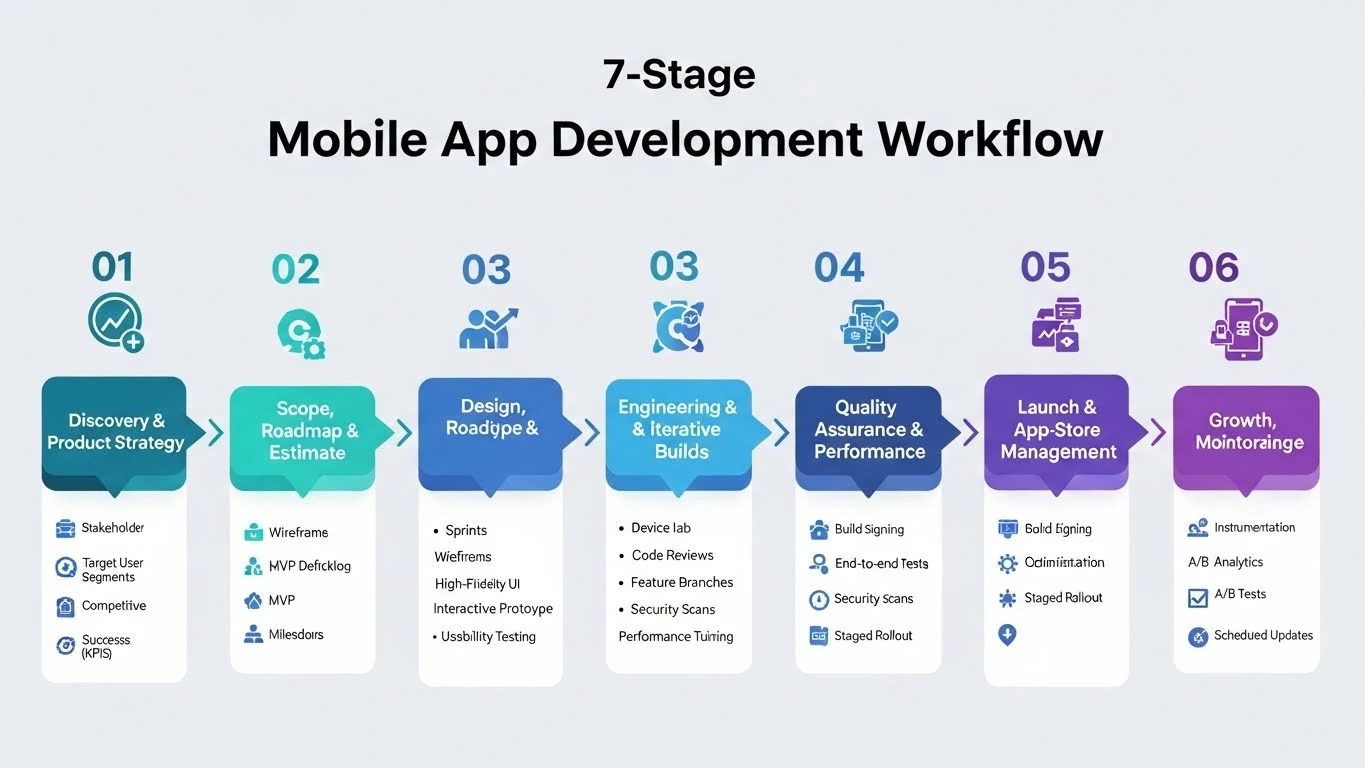
Step-by-Step Process
Discovery / Product Strategy – Interview with the stakeholders, target audience, competitive, success measures (KPIs).
Scope, Roadmap and Estimate, the priority of the backlog, the definition of MVP, milestones, SOW.
Design & Prototype wireframes, high-fidelity UI, interactive prototype, usability testing.
Engineering & Recurring Builds – sprints, code reviews, feature branches, CI/CD including automated testing.
Quality Assurance and Performance – device lab testing, end to end testing, security scans, performance imploration.
Launch, App-Store Management – sign building, optimization of store listing, rollout.
Growth, Monitoring & Maintenance Instrumentation, analytics, A/B tests, retention features, scheduled updates.
The 7 steps that Garage2Global takes to deliver successful mobile apps.
Case Studies and Success Stories.
Client: [RetailCo] (placeholder)
Challenge: RetailCo had to have a mobile application to supplement its web store to get more repeat purchases and less cart abandonment amongst mobile users. Their product information was not consistent and their checkout was slow.
Solution: Solution: Garage 2 Global developers of Solution: Garage2Global created a 10-week MVP including a native iOS app and a React Native Android application that shared the business logic. Key features: one-tap checkout with saved card tokens, product syncing offline and push personalization. Month two The team instrumented the critical funnels and conducted two checkout A/B tests.
Findings: In 90 days after launch: 28 percent improvement in mobile conversion rate and 18 percent in repeat purchase rate. [sample statistic].
Technology Stack and Platforms We use.
The reason behind our choice of certain platforms: we select based on the performance requirements, time of market entry, maintainability, and the budget constraints of the clients. Garage2Global trades between native performance (Swift/Kotlin) and quick cross platform development (Flutter/React Native) and connects them to cloud theory (AWS/GCP/Firebase) based on scale.
Common stack (example):
Frontend Swift, Kotlin, Flutter, react native.
Backend: Node.js (Express / Nest ), Python (Django / Fast API), Ruby on Rails (select cases).
Data: PostgreSQL, Redis, Firebase Auth, OAuth2.
Infrastructure: AWS (EKS, Lambda), GCP (Cloud Run), CI/CD with GitHub Actions / Bitrise / Fastlane.
Analytics/ A/B Firebase analytics, Amplitude, mix panel.
Payments Stripe, Braintree, local PSPs.
Test: Appium, Detox, XCTest, Espresso, BrowserStack/DeviceFarm.
Platform/ Best/ Pros/ Cons Garage2Global Fit.
— | — | — | — | —
Swift (iOS native) Performance sensitive iOS apps, animation intensive Performance, best access to the Apple ecosystem iOS single iOS Only, independent Android work Use when iOS UX/perf is important.
Kotlin (Android native) Kotlin is a performance-sensitive Android app, with native features, powerful tooling, Android maintenance only, and may be used in Android-focused features.
React Native Cross-platform applications, quick MVPs, single codebase, massive library ecosystem, caveats of performance with heavy animations, suited to business apps, lower TTM.
Flutter Pixel-perfect UI, cross-platform Strong performance, consistent UI Larger binary sizes under some circumstances Great brand-driven UI experiences.
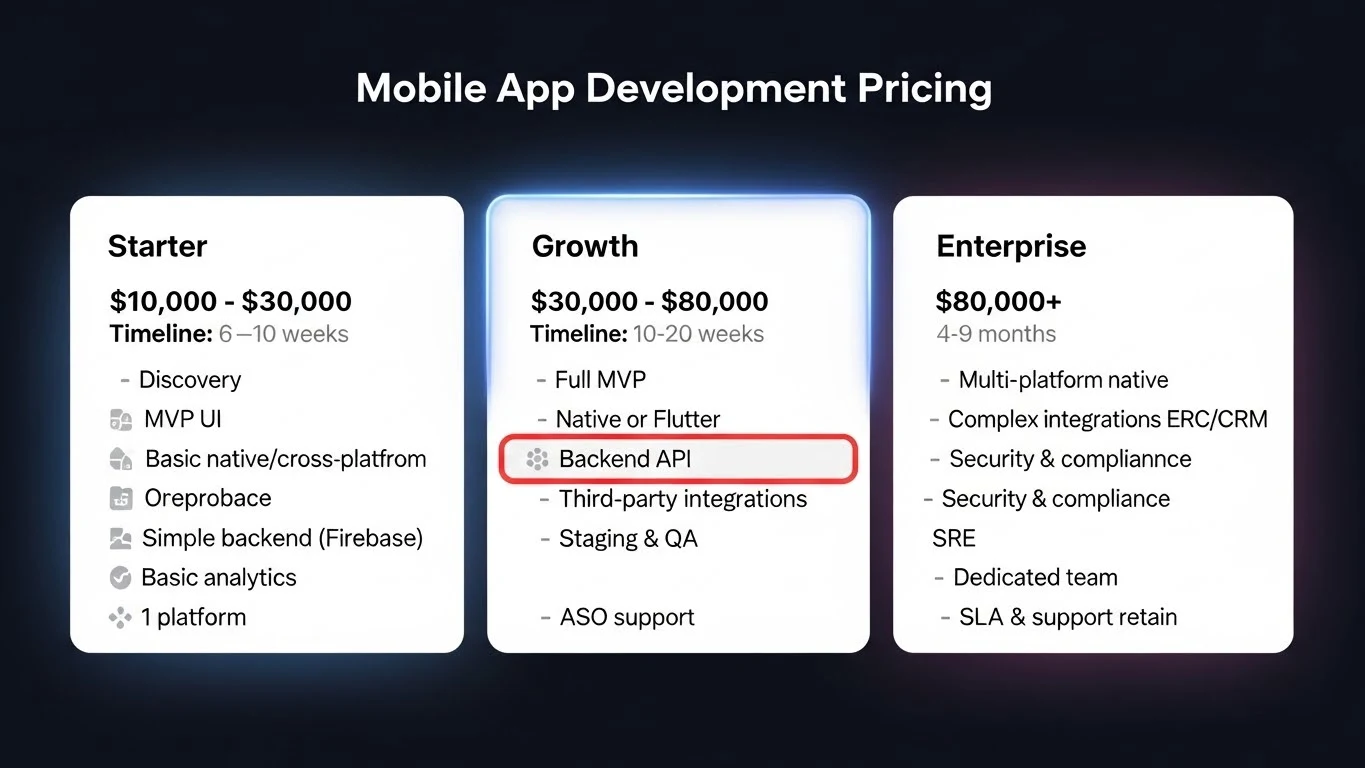
Cost of mobile app developers at garage 2 global Services.
Tier | Estimated price range (USD) | Estimated time range | features included.
— | —: | — | —
Starter Starter plans include $10,000 -30,000 6-10 weeks Discovery, MVP UI, rudimentary native/cross platform, simple backend (Firebase), simple analytics, one platform.
Growth -30,000 to 80,000-10-20 weeks-Full MVP, native or Flutter, backend API, payments, third-party integrations, staging and QA, ASO support
Enterprise Enterprise plans have no fixed pricing, but typically require 4-9 months, on multi-platform native, complex integrations (ERP/CRM), security/compliance, SRE, dedicated team, SLA and support retainer.
Open pricing on Starter, Growth, and Enterprise app projects.
Common Challenges & How Garage2Global Solves Them
Lack of clarity in product scope – Solution: Conduct a defined discovery sprint that includes validated prototypes to cut down on the re-work.
Delays to market – Solution: Cross-platform MVPs (Flutter/React Native) and feature flags should be recommended as a way of fast release.
Rejection of apps in the app stores – Solution: Pre-submission checklist in QA, compliance review, and advanced store submission engineers.
Older devices performance problems – Solution: Profile, lazy loading, optimized assets, and low-end devices.
Data privacy/compliance – Solution: Limited PII data gathering, consent forms, encrypted data storage and audit logs.
High maintenance cost – Solution: Modular architecture and common code libraries to minimize the cost of updates.
Complexity of integration with legacy systems Solution API gateways, middleware adapters, and batch sync strategies.
Low retention – Solution: Instrument cohorts, push flows, and iterate features on analytics.
Inconsistency in design – Solution: Design system and component library; cross-application and cross-release reuse.
Load testing of backend – Solution: Automatic scaling of cloud infrastructure, queue patterns, and performance testing.
Future Trends
On-device AI/ML: Greater localization and inference to ensure privacy and minimize latency. It allows such features as intelligent suggestions, offline recommendations, and quicker image processing without transmitting raw data to servers.
Composable mobile backends: microservices architecture for mobile apps Mobile projects will prefer applications to microservices and backend composability to be able to replace parts (payments, messaging, analytics) fast. This enhances serviceability and is less vendor lock-in.
Adaptive experiences (contextual UI): Applications adapt more extensively to user context (location, battery, network) to deliver thinner experiences on limited devices.
Edge-levels and offline-first UX Edge capabilities Progressive synchronization, local stores and conflict, will be enabled to be more resilient.
Better store governance/platform policies: Compliance and monitoring should be added to the release pipelines by the App teams; compliance automation is needed in release agility.
Web – App synergies (PWAs + native): Radical Web Apps will remain a legitimate discovery channel, but native applications will have an upper hand in deep integration into the OS.
Sustainability code: Developers will compare and optimize energy use as app KPIs to achieve corporate sustainability.
Summary that is voice friendly (speakable):
Looks forward to more smart capabilities on the device, modular backends, and context-specific apps. After 2025, privacy and effective performance are going to be table stakes.
FREQUENTLY ASKED QUESTIONS
What are the services offered by mobile app developers in Garage 2 Global?
Garage2Global provides product discovery, user experience design, native and cross-platform development (iOS/Android), backend APIs, payment integration, and quality assurance, application submission to app-stores and maintenance. They match the engineers to product managers so that the work can be aligned to the quantifiable business KPIs.
What is the average time it takes to develop an average mobile app?
Timeline varies by scope. The simplest MVP can be released within 6-10 weeks; a complete multi-platform product with the integrations on the back-end side will take 10-20 weeks. Custom integrations and compliance projects may require months to make.
In what type of apps do you develop native or cross-platform?
Both. The team suggests native Swift/Kotlin to be used in performance sensitive features and Flutter/React Native to use in cross platform MVPs when faster. The decision is made based on the performance requirements, the complexity of the UX as well as its long-term maintenance.
What is the cost of recruiting mobile app developers at garage 2 global?
Starter, Growth, and Enterprise cost representative are between $10k and 30k, 30k and 80k, and 80k and higher respectfully. The ultimate cost is determined based on integrations, compliance and feature complexity.
Will you deal with submissions of apps-stores?
Yes. The team takes care of signing build, metadata of the stores, localized screenshots and rollouts to make the review process smoother and get the acceptance quicker.
Measuring post-launch success?
Some metrics of success are active users, retention (day-7, day-30), conversion rate, ARPU, crash rates, and feature adoption. Garage2Global defines KPIs that can be measured at the discovery stage and monitors them using dashboards.
What are the categories of apps that Garage2Global focuses on?
They develop ecommerce, telehealth, edtech, B2B productivity, social and lifestyle applications. The team customizes the stack to every industry (e.g. HIPAA requirements of health apps).
The products of garage 2 global are developed by mobile app developers at garage 2 global who bring ideas to life by combining product strategy, modern engineering practice, and playbooks that can be measured to transform them into high-performing mobile products. There are the entire 7-steps workflow, three brief case studies, a technology comparison table, pricing examples, ROI calculation, typical challenge solutions, and publish-ready JSON-LD schemas in this pillar guide, which will transform visitors into qualified leads. Ready to move forward? Get a free product audit and a special roadmap by the product experts at Contact Garage2Global.